Executed trades show transactions that happened. An order book shows resting orders that may disappear. Combining them requires timestamps, venue context and clear limitations.
Separate transactions from intentions
A depth snapshot is a view of displayed liquidity at one instant. It does not prove that a large participant will keep an order in place. Executed flow records trades that matched, but aggressor classification can depend on the feed’s maker flag or classification method. A buyer-initiated trade still has a seller on the other side. “More aggressive buying” is not the same claim as “more buyers than sellers.”
Read delta within its observation window
For a feed that identifies aggressors, delta can be defined as buy-initiated volume minus sell-initiated volume over a stated window. Specify whether volume is base units or quote value. A positive delta alongside a flat price can be consistent with absorption, but it does not prove a reversal or identify a participant. Confirm price response rather than converting one number into a trading trigger.
Explore prepared market patterns, then check the observation time and invalidation.
A worked contradiction
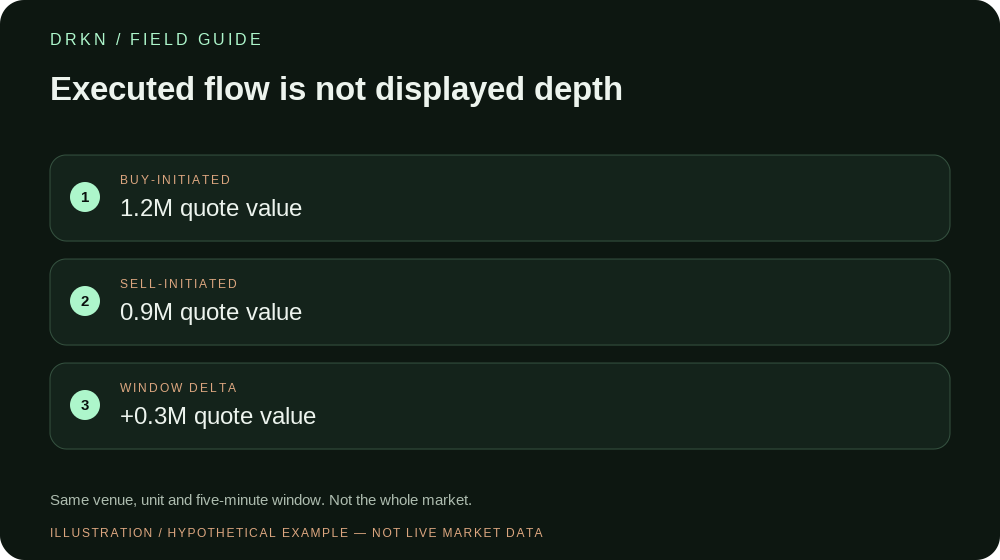
Imagine a five-minute window with 1.2 million units of quote-value aggressive buying and 0.9 million of selling. Delta is positive 0.3 million. If price fails to cross resistance while offers replenish, the bullish interpretation is weaker than the delta alone suggests. A separate bullish scenario needs observable acceptance above resistance; a failed-breakout scenario needs a defined invalidation. No current price, real order or win probability is implied by this example.
Use DRKN with venue boundaries
In a DRKN analysis, inspect which executed-flow and depth inputs were actually available. Spot flow from one exchange is not the entire crypto market and cannot be silently substituted for futures positioning. Missing flow must remain missing, rather than being inferred from candle volume. Compare the observation time with the chart time, and use the research as one input alongside volatility, risk budget and transaction costs.
A five-field check before using flow in a scenario
Use the same venue, instrument, time window, volume unit and aggressor-classification method before comparing two flow numbers. With 1.2 million quote-value buy-initiated trades and 0.9 million sell-initiated trades in one five-minute window, delta is +0.3 million. That calculation says nothing about activity on other venues. If price cannot hold above resistance, positive delta alone does not confirm a breakout. Ask what observation would invalidate the bullish interpretation, and keep unavailable depth or futures data explicitly unavailable. Compare that with the pattern-confirmation guide, rather than treating a large resting order as an executed purchase.
Sources and scope
Examples are hypothetical and educational, not personal advice or a profit guarantee. DRKN feature descriptions are based on the current implementation; an external reference does not endorse DRKN or validate its accuracy.
Inspect the evidence together
Explore prepared market patterns, then check the observation time and invalidation.
Explore market patternsA question to take with you
How should I compare price, news and executed-flow evidence? Separate data freshness, opposing evidence and invalidation.